
 uk
uk 
Arthur, an officer with 20 years of service experience, is now studying project management:
“Thanks to the Academy, I am gaining modern knowledge and practical tools that will help me work effectively in the civilian sector.”
These stories are part of a larger shift. Since the Academy was founded, more than 150 veterans have already completed training or educational programs. As of February 2026, some graduates are working at IT companies, including EveryMatrix and Stepico Games, where they were hired during their internships.
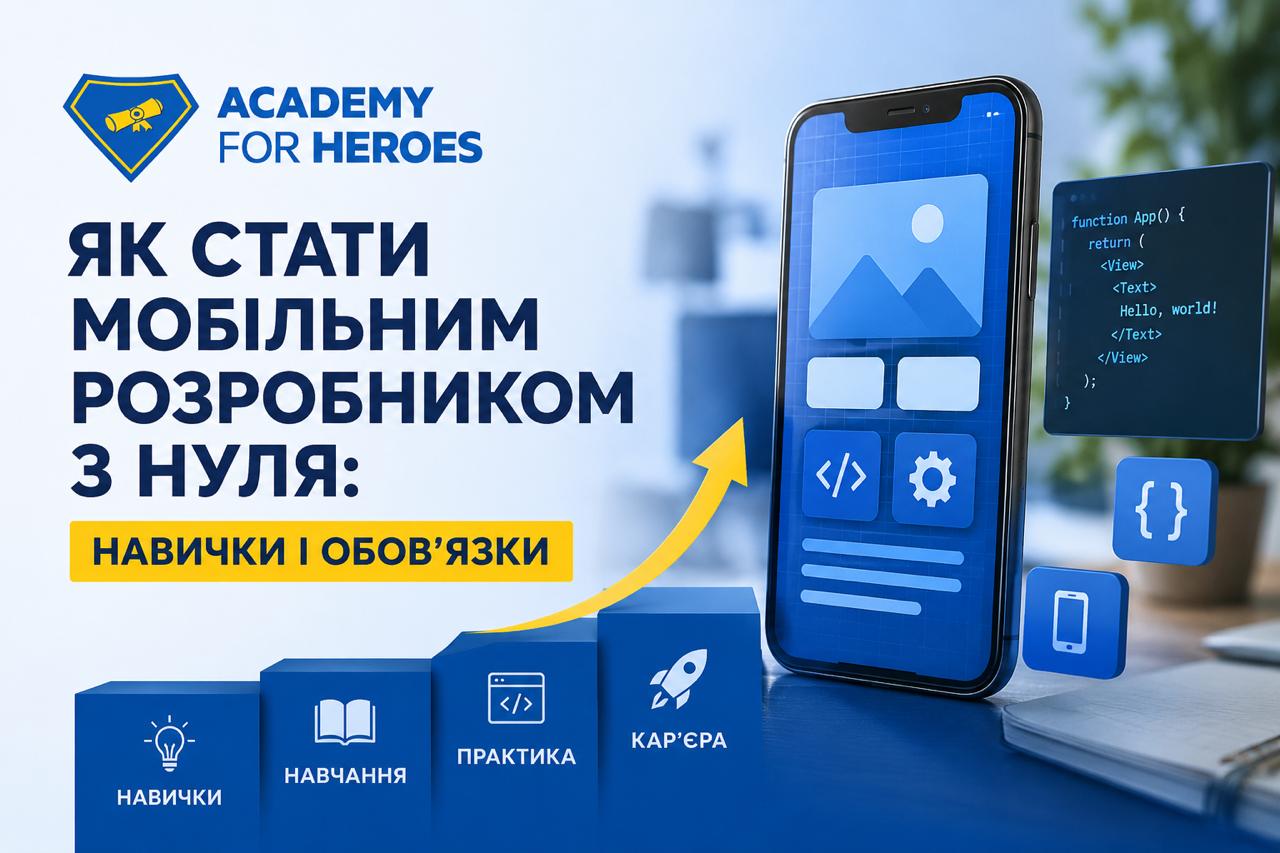
One of the areas generating the most interest among the Academy’s students today is mobile development. And it is no surprise: mobile development remains one of the most practical ways to enter IT even without prior technical experience.
Why mobile development is one of the most promising fields in IT
Banks, delivery services, healthcare platforms, logistics companies, government services — almost every company today has its own mobile application. As a result, demand for mobile developers persists even in a challenging market. However, it is important to understand: companies no longer need “theorists who completed a course.” Businesses are looking for people who can build real products and work in a team. That is why modern mobile development education is increasingly shifting toward practice: team projects, internships, and hands-on work with a technology stack (a set of tools, programming languages, frameworks, and databases used together to develop and run software products).
For veterans, this is especially relevant: IT is one of the few fields where you can change careers without years of retraining, and military experience — discipline, resilience under pressure, the ability to work in a team — is a competitive advantage.
Who is a React Native Developer and why this technology
A React Native Developer is a mobile developer who builds applications for both iOS and Android simultaneously using JavaScript and TypeScript.
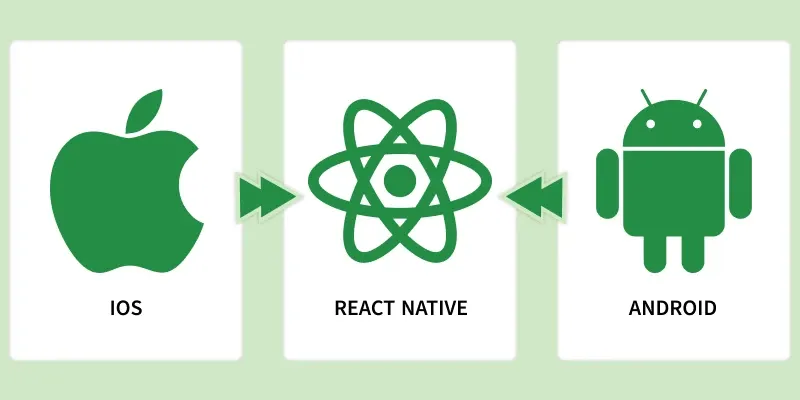
Just a few years ago, companies had to hire a separate iOS developer, an Android developer, and a frontend team. Cross-platform development changed that model: one developer can cover both platforms, allowing products to be launched faster and at lower cost. That is why React Native has become one of the most popular stacks for startups, product companies, and outsourcing firms.
For a newcomer without an IT background, React Native has another advantage: it is built on JavaScript — the language most web development programs teach first. This means that foundational knowledge immediately opens up several directions to explore.
What a mobile application developer does on a team
In a typical team, a mobile developer:
- builds the application interface and implements the design in code;
- integrates the backend via API — that is, connects the application to the database and business logic;
- sets up authorization, push notifications, and offline functionality;
- optimizes performance and fixes bugs;
- tests the application before release;
- publishes updates to the App Store and Google Play.
In practice, this means working on real business tasks: a food delivery app, a CRM for logistics, a booking service, mobile banking, a corporate accounting system, and so on.
What technologies to learn in 2026
The market has long moved past the “learn one language and you’re a programmer” approach. A junior mobile developer in 2026 needs to understand an entire ecosystem of tools.
Core React Native Developer stack:
- JavaScript and TypeScript — the development languages. TypeScript is a strictly typed version of JavaScript that helps avoid errors in large projects.
- React and React Native — a library for building interfaces and its mobile counterpart.
- Git / GitHub — a version control system that every team relies on.
- REST API — the way an application “talks” to a server.
- React Query and Zustand — tools for managing data within the application.
- Supabase — a modern cloud database that allows you to launch a backend quickly without writing server-side code.
- Jest and React Native Testing Library — tools for automated testing.
AI tools used by teams: GitHub Copilot, ChatGPT, and Cursor AI help write code faster and catch errors. However, it is important to understand: AI does not replace a developer — it only speeds up the work of someone who already understands the architecture and logic of the application.
What junior mobile developers are expected to know
In 2026, employers pay far less attention to diplomas and certificates, and much more to practical skills and completed projects.
Interviews typically assess:
- GitHub profile — whether there is real code and how frequently the person updates it;
- pet projects — applications built independently or as part of a team;
- team experience — whether the person can work in Agile/Scrum and participate in code reviews;
- a basic understanding of architecture — why the code is structured the way it is;
- soft skills — communication, independence, and the ability to ask the right questions;
- English at B1 level or above — most documentation and most employers require at least the ability to read technical texts.
That is exactly why the lack of practical experience is a major problem with many online courses: a person may watch 200 hours of video yet still have no idea what a real production project looks like or how people actually work within one.
How much does a mobile developer earn in Ukraine
According to DOU.ua and Djinni, in 2026:
- Junior React Native Developer — approximately $600–1,200 per month;
- Middle Mobile Developer — $2,000–3,500+;
- Senior Mobile Developer — $4,500+.
Candidates with a portfolio, team development or internship experience, and English at B1 or above have the best chances of finding a job quickly.
Why internships matter more than course certificates for newcomers right now
In 2026, the mere fact of having completed a course surprises almost no one — the market is saturated with graduates who have only theoretical knowledge. Companies, on the other hand, value real experience: completed applications, team development, and an understanding of how workflows operate.
This is where the key advantage of programs that include internships becomes clear. Veterans of the Academy for Heroes complete internships at companies such as EveryMatrix, Stepico Games, ELEKS, and ArchySoft. During those internships, some of them made a strong enough impression to receive their first job offer.

How veterans can learn mobile development for free in Lviv
The Academy for Heroes is an educational initiative that provides free training in modern IT professions to veterans, members of their families, and people from vulnerable groups.
The curricula are developed and reviewed by faculty and professors of Lviv Polytechnic together with leading IT specialists. The Mobile Development program runs for 8 months and is built around practice rather than lectures.
What the program includes:
- mobile application development with React Native using a modern JS/TS stack;
- teamwork using the Agile/Scrum methodology;
- mentorship from practicing developers;
- English for IT and a speaking club;
- resume preparation and technical interview coaching;
- internships at IT companies;
- free access to the Udemy learning platform;
- “Heroes’ Club” — an online space with materials, class recordings, and a community.
Classes are held in the evenings, making it easy to combine studying with work or family responsibilities. The location is a training center in Lviv at 3 Ye. Petrushevycha Square. The space is wheelchair accessible, has a stable power supply, and is equipped with all necessary technology.

Upon completing the program, graduates receive a certificate worth 30 ECTS credits, a finished mobile application for their portfolio, and hands-on team development experience.
“We deliberately build the program around real mobile development tasks rather than theory alone. Our goal is for graduates to be able to show an employer a finished application and understand how a modern IT team operates,” — Oleksiy Druhov, Head of the Academy for Heroes, Professor at Lviv Polytechnic.
Denys came to study almost by chance — on his wife’s advice. Today he already has his own project idea and the support of the community. For Vasyl, Viktor, Arthur, and dozens of other veterans, the Academy has become not only a place of learning, but an environment where self-confidence is restored and a vision for the future begins to take shape. Join us!

