
 uk
uk 

Social Media Marketing (SMM): About the Profession
SMM (Social Media Marketing) is a fully-fledged marketing discipline that combines strategic thinking, analytics, copywriting, a basic understanding of design, and the ability to work with advertising platforms. Sounds like a lot? In reality, all of this can be learned step by step if you have a clear plan and the right learning system.
A typical SMM manager’s day looks roughly like this:
- Morning: analyzing yesterday’s post statistics — what worked, what didn’t, and why
- Before lunch: writing and editing copy for Instagram and Facebook (or other social networks), coordinating with the client
- After lunch: setting up or adjusting targeted ads in Facebook Ads Manager
- Evening: responding to comments, monitoring brand mentions, preparing a content plan/strategy
The actual scope of work depends on the company. At a startup or small business, an SMM specialist often does everything themselves: writes, shoots, edits, sets up ads, and analyzes results. At a large company, they develop the strategy and coordinate (assign tasks to a copywriter, designer, and targeting specialist, monitor results, and are responsible for the overall picture).
What an SMM Specialist Needs to Know and Be Able to Do
Here is the minimum required to realistically find your first job or client:
1. Understanding At Least One Platform from the Inside
We all use social media. But an SMM manager looks at it differently — as a tool with a clear logic. At the start, knowing one platform well is enough. For most Ukrainian businesses, Instagram is currently the primary platform.
2. Content Thinking
This is not just about “being able to write copy” — it’s about understanding for whom and why you are publishing each post. A content strategy must answer 3 questions:
- What problem or need does the product address?
- Why should the audience trust the brand?
- How does the content gradually guide a person from their first encounter to conversion?
3. Basic Copywriting Skills
An SMM manager works extensively with text: writing posts, Stories, Reels scripts, descriptions, and ad creatives. Over time, they develop a better understanding of which formats, styles, and messages work best for a specific audience.
4. Working with Visuals
The minimum to master is Canva or another simple editor at a confident user level. It is also important to understand the basic principles of composition, color, typography, and visual presentation in order to effectively “package” content and make it appealing to the audience.
Even with free tools, it is possible to create professional visuals if you have a sense of structure, style, and attention to detail.
5. Basic Understanding of Targeted Advertising
Facebook/Instagram Ads is an essential tool. Even if the company has a targeting specialist, an SMM manager needs to understand the logic of ad platforms in order to assign tasks competently and read reports.
6. Working with AI Tools
Today, AI tools have become part of the SMM specialist’s daily work. They help generate ideas, create content, edit videos, and automate routine tasks. The minimum skill set includes: generating and editing text (ChatGPT, Claude), creating visuals (Midjourney, Canva AI), and video editing with AI features (CapCut).
However, the key here is not to use AI “blindly,” but to understand its limitations — that is, where it genuinely saves time, and where human creativity, taste, and critical thinking are indispensable.
7. Analytics
Meta Business Suite and the native analytics of platforms — you need to be able to read the numbers and draw conclusions from them. Reach is growing but sales are not? That means the problem may not be in traffic, but in the content, the offer, or the funnel. An SMM specialist who does not work with analytics is essentially working blind.

How to Become an SMM Manager from Scratch
Step 1. Determine Why You Want This (and Whether This Profession Is Right for You)
It sounds obvious, but it matters. SMM is right for you if:
- you can open TikTok or Instagram “for 5 minutes” and suddenly catch an idea for content;
- you enjoy working with text, visuals, video, and anything that can be presented beautifully on social media;
- you notice trends before they go mainstream;
- you can turn an ordinary post into something people want to like, save, and share with friends;
- you enjoy experimenting, testing new formats, and are not afraid of the phrase “let’s try it this way”;
- you have plenty of ideas and don’t wait for inspiration — you create it;
- you adapt quickly to change: today there’s a new algorithm, tomorrow a new trend, and you’re already up to speed;
- you want freedom: to work remotely, run your own projects, or go freelance;
- you can strike a balance between creativity and responsibility;
- you love the feeling when your content genuinely evokes emotions and reactions from people.
SMM is about the ability to capture attention, create a style, build a community, and bring brands to life. Did you recognize yourself in at least half of these points? Then now is the perfect time to try this profession.
Step 2. Learn!
There are 2 options: self-study and a structured course. Let’s take a closer look.
On your own: YouTube, free courses from Meta Blueprint, Coursera, blogs, and practitioner case studies. The downside — there is no system, no feedback, and no deadlines to keep you moving.
A course: allows you to learn not from your own mistakes, but from the experience of instructors and the case studies of other students. You get a structured program, live interaction, and personalized feedback. This helps you grasp the subject faster, avoid common mistakes, and confidently apply your knowledge in practice.
What to look for when choosing a learning program:
- Hands-on practice with real projects, not just lectures. A good course gives you the opportunity to immediately apply your knowledge in practice and build a portfolio.
- An up-to-date curriculum. If a course launched in 2026 does not cover modern tools, it may be a sign that the program is already outdated.
- Graduate reviews with specific results. This is a plus, but not the only criterion. If there are no success stories on the website, look for other indicators of quality: whether student work is showcased, whether there are open case studies, who teaches the course, and what practical experience the mentors have. It is also worth looking for independent reviews on Google, social media, or professional communities. The main thing is to make sure the course delivers real results, not just attractive promises.
Step 3. Practice on Real Accounts and Start Building Your Portfolio Right Away
The most common mistake beginners make is waiting until they have “fully learned” before moving on to practice. We recommend building your portfolio during the learning process itself, even if you don’t yet have commercial clients.
How to gain practical experience:
- Run your own thematic account (for example, about learning or your professional niche).
- Offer free or low-cost help to an entrepreneur you know.
- Conduct a notional audit of a real brand’s account and present it as a case study.
- Create a sample content plan or content strategy for a real or fictional business.
What to include in a beginner SMM manager’s portfolio:
- Screenshots of accounts you managed (even if it’s your own page)
- Developed visual identity for an account — color palette, fonts, templates
- Sample content plans with an explanation of the logic behind them
- Content strategies for specific niches
- Competitor analysis: how you researched the niche and what conclusions you drew
- Case studies with a description of results: what was done and what changes it produced
- Examples of ad creatives — copy, visuals, audience targeting settings
- Screenshots of analytics with commentary: what these numbers mean and why they changed
- Examples of handling negative feedback or a crisis situation in the comments
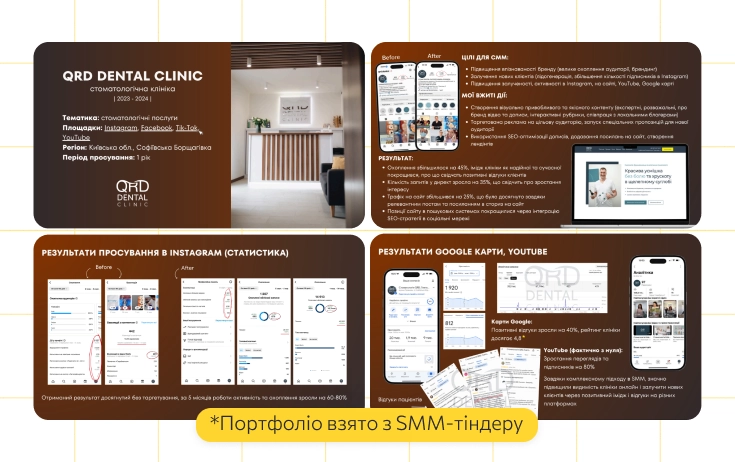
You don’t need dozens of case studies. Two or three quality examples that demonstrate your approach, analytical thinking, and practical skills are enough.
Step 4. Learn How to Write a Resume and Prepare for an Interview
Dozens of people apply for a single vacancy. Your resume is what makes a recruiter stop at yours.
Common mistakes in a junior SMM resume:
- Generic phrases without specific examples. Wording like “manage social media” gives an employer no understanding of what you actually did or what results you achieved. Instead, briefly describe your tasks and, where possible, include numbers. For example: “Created content for a local café’s Instagram page and grew the account’s reach from 500 to 2,800 in 3 months.”
- No links to actual work samples. If an employer cannot see examples of your work, it is harder for them to assess your skills.
- Vague positioning. Your resume must make it immediately clear which role you are applying for: SMM manager, targeting specialist, content manager, or another specialization.
For the interview, prepare for practical questions: “What would you do with this account?”, “How would you build a content strategy for our product?” and similar.
Step 5. Look for Your First Job and Don’t Be Afraid to Start Small
An SMM manager’s first job is rarely ideal — and that’s normal. A small agency, a local business, a first freelance project for modest pay. At this stage, the priority is not the salary, but the experience and the understanding of how everything works in practice.
Step 6. Develop Systematically
Don’t stop after getting started. In SMM, everything changes very quickly, so without continuous learning it is easy to lose relevance.
Skills worth gradually developing to grow in the profession:
- Advanced targeted advertising and analytics
- Working with AI tools for content (ChatGPT, Midjourney, CapCut AI, etc.)
- Strategy and personal brand building
- SEO basics for social media
- Email marketing as an adjacent competency
Where to Take Free SMM Courses
Want to learn how to manage social media professionally, rather than by guesswork? Then take a look at the free offline SMM course launching in Lviv in June 2026.
The program is implemented in partnership between the NGO “Academy for Heroes” and the Lviv Regional Organization of the Ukrainian Red Cross Society.
What the Course Covers
The program is designed to provide not only theory, but also the practical skills that an SMM manager genuinely needs today. Specifically, you will learn to:
- create SMM strategies and position brands;
- analyze target audiences and competitors;
- develop content strategies and content plans;
- write copy, work with storytelling and Tone of Voice;
- create photo and video content for social media;
- understand the algorithms of Instagram, TikTok, and Facebook;
- work with audience engagement and community building;
- launch targeted advertising and analyze KPIs;
- use automation and modern AI tools;
- build a personal brand and present yourself as a specialist.
Special attention will be given to working with real case studies, practical assignments, and creating your own project to add to your portfolio.
Who the Program Is For
Participation in the program is free of charge for members of vulnerable population groups. Check whether you fall into the vulnerable persons category.
Places are limited!

Many Academy graduates have already changed careers. Read their stories here: https://www.academy4heroes.com/en/category/student-stories/.
Details and registration at the link: https://www.academy4heroes.com/en/educational-programs/free-smm-course-in-lviv/.

